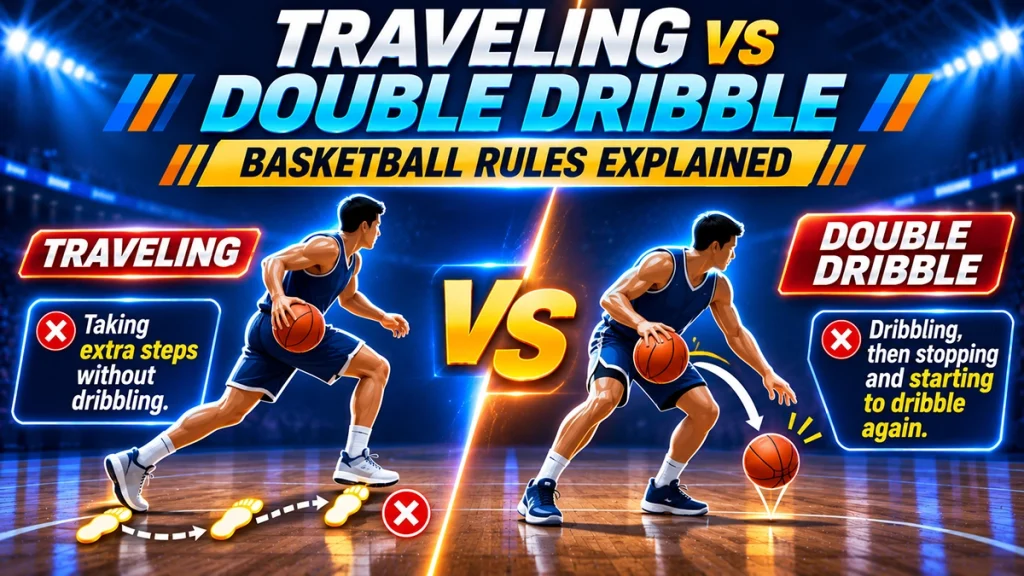
A basketball player drives towards the basket, the referee blows the whistle, and the opposing team gets possession.
Was it traveling or a double dribble?
Both are common basketball violations, but they involve different actions.
Traveling concerns illegal foot movement while controlling the ball. Double dribble concerns illegally continuing or restarting a dribble.
Understanding the difference makes it easier to follow NBA, PBA and international basketball games.
At ArenaLive, we help Filipino basketball fans follow available basketball schedules, scores and results in Philippine Time (PHT, UTC+8).
Here’s how traveling and double dribble rules work, including the gather step, pivot foot, legal dribbling and what happens when a violation is called.
Traveling vs Double Dribble: What’s the Difference?
The simplest way to distinguish these violations is to focus on what the player does with the ball.
| Rule | Traveling | Double Dribble |
|---|---|---|
| Main issue | Illegal foot movement | Illegal dribbling |
| Common example | Taking too many steps after gathering | Dribbling again after ending a dribble |
| Important concept | Pivot foot and gather | When a dribble begins and ends |
| Typical consequence | Loss of possession | Loss of possession |
| Personal foul? | No | No |
Both violations normally result in the opposing team receiving possession for a throw-in.
Neither is automatically a personal foul, and neither normally awards free throws.
However, the details of each situation matter when deciding whether a violation occurred.
What Is Traveling in Basketball?
Traveling happens when a player moves one or both feet illegally while holding or controlling the ball.
The rules allow players to move with the ball, but only within specific limits.
For example, a player cannot simply catch a pass and run across the court without dribbling.
However, not every movement involving the feet is traveling.
Players are allowed to pivot, take legal steps after gathering the ball and perform certain movements when shooting or passing.
Example of a Traveling Violation
Imagine a player dribbling towards the basket.
The player gathers the ball, takes more than the permitted steps and attempts a layup.
If the movement exceeds the applicable step limit, the referee can call traveling.
Another example occurs when a player receives the ball while standing still and illegally moves their pivot foot before beginning a dribble.
To understand why these actions are illegal, you need to know how the pivot foot works.
What Is a Pivot Foot?
A pivot foot is the foot that must remain at its established point of contact with the floor while a player pivots with the ball.
The other foot can move to help the player turn, protect the ball or find a passing opportunity.
For example, a player catches the ball while standing with both feet on the floor.
When one foot is lifted, the other becomes the pivot foot.
The player can then turn using that pivot foot.
But the player cannot move it illegally to gain an advantage.
Can You Lift Your Pivot Foot?
Yes, in certain situations.
A player may lift their pivot foot to pass or shoot, provided the ball is released before that foot returns to the floor.
Starting a dribble is different.
Under NBA rules, when beginning a dribble from a legal stop, the ball must leave the player’s hand before the pivot foot is raised.
This distinction is important because lifting the pivot foot is not automatically traveling.
The legality depends on what the player does next.
What Is the Gather Step in Basketball?
The gather is an important concept when watching NBA basketball.
A player who is dribbling must eventually gain control of the ball before passing, shooting or stopping.
This moment is called the gather.
Under NBA rules, a player progressing with the ball may generally take two legal steps after gathering to stop, pass or shoot.
The first step is counted when a foot, or both feet, contacts the floor after the gather.
The second step follows under the applicable movement rules.
Why Do Some NBA Layups Look Like Three Steps?
Sometimes a player appears to take three steps during a layup.
However, the foot already on the floor at the moment of the gather is not necessarily counted as the first of the two permitted steps.
This creates confusion when fans count foot contacts without identifying when the player actually gained control of the ball.
A useful way to analyse the movement is:
Gather the ball → First legal step → Second legal step → Release the ball
This is a simplified example. Actual rulings also depend on the player’s footwork, timing and whether the movement follows the other traveling provisions.
Not every movement that looks unusual is automatically illegal.
What Is Double Dribble in Basketball?
A double dribble occurs when a player illegally begins another dribble after the first dribble has ended.
For example, imagine a point guard dribbling towards the basket.
The player stops, catches the ball securely with both hands and looks for a teammate.
Instead of passing or shooting, the player starts bouncing the ball again.
That is normally a double-dribble violation.
Once a player voluntarily ends a legal dribble, they generally cannot simply start another one.
Does Using Two Hands Always Mean Double Dribble?
Not necessarily.
Using both hands to secure the ball usually ends the current dribble.
The violation generally occurs if the player then illegally begins another dribble.
Also, a player does not commit double dribble merely by switching from their right hand to their left while maintaining a continuous legal dribble.
The ball must be handled according to the dribbling rules.
A normal crossover between hands is allowed.
Can a Player Dribble Again After Losing the Ball?
Sometimes, yes.
Basketball rules contain exceptions for certain situations in which a player loses control of the ball.
For example, an opponent touching the ball can affect whether a new dribble is permitted.
Under NBA rules, other specified events involving a shot attempt, pass or fumble may also allow another dribble.
However, simply dropping the ball deliberately does not automatically reset the player’s dribbling rights.
The referee considers how the player lost control and what happened before they regained it.
This is why two similar-looking plays can receive different decisions.
What Is Carrying the Ball?
Carrying, sometimes called palming, is another illegal dribbling action.
It is related to double dribble but is often discussed separately.
Carrying can occur when a player places a hand underneath the basketball, allows it to come to rest or pauses it in a prohibited manner while continuing the dribble.
For example, a player may appear to hold the ball from underneath before bouncing it again.
The referee may determine that the dribble was illegally discontinued.
However, placing a hand on the side of the ball during a normal crossover is not automatically carrying.
The key question is whether the player illegally supported, rested or paused the basketball.
Modern ball-handling moves can happen quickly, so the exact movement matters.
What Happens After Traveling or Double Dribble?
Both are violations rather than ordinary personal fouls.
When a violation is called, the whistle stops play.
The offending team normally loses possession, and the opponent receives the ball for a throw-in at the location required by the applicable rules.
Consider these hypothetical situations.
Example 1: Traveling
A player catches the ball and illegally moves their pivot foot.
The referee calls traveling.
The opposing team receives possession.
Example 2: Double Dribble
A player ends their dribble by holding the ball with both hands, then starts dribbling again without a permitted intervening event.
The referee calls double dribble.
The opposing team receives possession.
Neither violation automatically adds a personal foul to the player’s total.
Neither normally results in free throws.
Are Traveling and Double Dribble Rules the Same in NBA and FIBA?
NBA and FIBA basketball follow similar basic principles concerning legal steps, pivoting and dribbling.
Both recognise traveling and illegal dribbling violations.
However, the two organisations publish separate rulebooks, and some definitions, interpretations and procedures may differ.
For this reason, fans should avoid assuming that every borderline movement will be judged identically across competitions.
When watching an international tournament, the applicable FIBA rules and official interpretations provide the appropriate reference.
For a wider comparison of the two systems, read our FIBA vs NBA Rules Explained guide.
Why Do Referees Sometimes Allow Unusual Footwork?
Basketball moves happen quickly.
A player may gather the ball while running, change direction, jump, pivot or attempt a shot within a very short period.
To determine whether traveling occurred, the official must identify when the player gained control and which foot movements followed.
For double dribble, the official must determine whether the player ended their first dribble and whether another dribble was legally permitted.
A move that looks illegal in slow motion may be legal under the applicable rules.
Likewise, an action that looks smooth at normal speed may still contain a violation.
Understanding the gather and pivot-foot rules is more useful than simply counting every apparent step.
How to Follow Basketball Games on ArenaLive
Understanding violations can help you follow the flow of a basketball game.
If a possession suddenly changes after a whistle, traveling or illegal dribbling may be one possible explanation.
However, a score alone cannot tell you which violation occurred.
At ArenaLive, you can check available fixtures, reported match statuses and confirmed scores through our NBA games and scores page.
Not every match includes detailed play-by-play information or officiating explanations.
If you want to understand how player responsibilities relate to ball-handling, our Basketball Positions Explained guide introduces the five traditional positions.
For a separate explanation of game clocks and playing periods, see our NBA Quarters Explained guide.
Match dates and scheduled times on ArenaLive are displayed in Philippine Time (PHT, UTC+8).
Frequently Asked Questions
What is the main difference between traveling and double dribble?
Traveling involves illegal movement of the feet while controlling the ball. Double dribble involves illegally continuing or restarting a dribble after it has ended.
Can an NBA player take two steps without dribbling?
A progressing player may generally take two legal steps after gathering the ball to stop, pass or shoot. The exact ruling depends on when control was established and how the steps were taken.
Is switching hands while dribbling a double dribble?
No. A normal legal crossover between hands does not automatically end the dribble. The ball must continue to be handled within the dribbling rules.
Does traveling count as a personal foul?
No. Traveling is a violation, not a personal foul. It normally results in the opposing team receiving possession.
Is carrying the ball the same as double dribble?
They are related illegal-dribbling concepts, but the actions can differ. Carrying concerns prohibited handling or pausing of the ball during a dribble, while double dribble generally involves illegally starting another dribble after the first has ended.
Understand Basketball Violations with ArenaLive
Traveling and double dribble can look similar because both involve a player controlling the basketball.
The important distinction is what makes the action illegal.
Traveling is about foot movement. Double dribble is about dribbling control.
Knowing how the gather step, pivot foot and dribbling rules work makes these decisions easier to understand.
Whether you’re following the NBA, PBA or international basketball, learning these fundamentals helps you appreciate the skill involved in legal ball-handling.
At ArenaLive, we help basketball fans across the Philippines follow available schedules, match scores and confirmed results in Philippine Time.
Understand the rules, follow the action and enjoy basketball with ArenaLive.