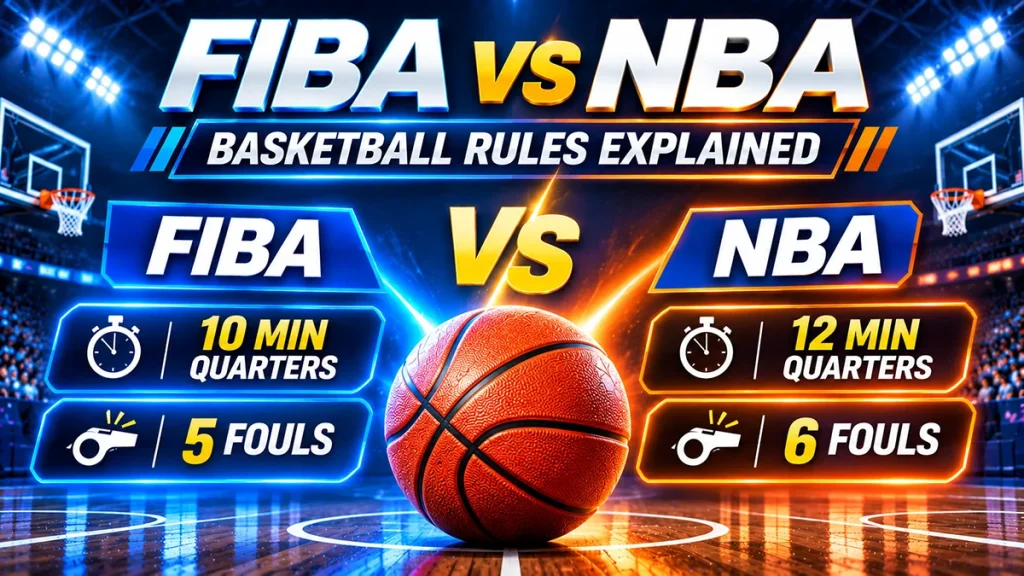
Why does an NBA player have six personal fouls available, while a player in a FIBA basketball game must leave after five? And why do international basketball games have shorter quarters?
For Filipino basketball fans who regularly follow the NBA and international competitions, these differences can sometimes be confusing.
Although both competitions use the same basic principles of basketball, FIBA and the NBA follow different playing rules.
FIBA updated its official basketball rules in October 2026, introducing several changes to foul classifications and officiating procedures.
At ArenaLive, we help fans in the Philippines follow available NBA and FIBA basketball schedules, match scores and results in Philippine Time (PHT, UTC+8).
Here’s what you need to know about the main differences between FIBA and NBA basketball rules.
What Is the Difference Between FIBA and the NBA?
FIBA stands for the International Basketball Federation.
It governs international basketball and publishes the official playing rules used across FIBA-sanctioned competitions.
The NBA, or National Basketball Association, is a professional basketball league based in North America.
Both use five players per team on the court, with baskets worth one, two or three points depending on how they are scored.
However, their rulebooks differ in several important areas.
These include:
- The length of each quarter.
- The number of personal fouls allowed.
- The distance of the three-point line.
- The dimensions of the playing court.
- Certain possession and officiating procedures.
- Technical and other foul classifications.
Understanding these differences makes it easier to follow international basketball without applying NBA rules to every situation.
FIBA vs NBA Rules: Quick Comparison
Here is a comparison of the main playing rules in 2026.
| Rule | FIBA | NBA |
|---|---|---|
| Players on court | 5 per team | 5 per team |
| Regulation quarters | 4 × 10 minutes | 4 × 12 minutes |
| Total regulation time | 40 minutes | 48 minutes |
| Overtime | 5 minutes | 5 minutes |
| Personal foul limit | 5 | 6 |
| Three-point arc | 6.75 metres | 23 feet 9 inches |
| Court dimensions | 28 × 15 metres | 94 × 50 feet |
| Standard shot clock | 24 seconds | 24 seconds |
The three-point measurements refer to the main arc. Corner distances are shorter. The rules may also contain exceptions for particular game situations.
Although many basic rules are similar, small differences can affect substitutions, defensive tactics and late-game decisions.
Let’s examine the most important ones.
1. FIBA Games Have Shorter Quarters
One of the easiest differences to recognise is the game clock.
Under FIBA rules, a standard basketball game has four 10-minute quarters.
That produces 40 minutes of regulation playing time.
In the NBA, each quarter lasts 12 minutes, giving teams 48 minutes of regulation.
The difference is eight minutes.
This matters when comparing statistics across competitions.
An NBA player may have more regulation playing time available to accumulate points, rebounds and assists.
However, individual minutes still depend on coaching decisions, substitutions, fouls and game circumstances.
A player’s performance should not be compared using total points alone without considering playing time and other context.
For more information about NBA periods, read our NBA Quarters Explained guide.
2. FIBA Players Have Five Personal Fouls
The personal foul limit is another important difference.
In FIBA basketball, a player who reaches five personal fouls must leave the game.
Under NBA rules, a player generally becomes disqualified after committing a sixth personal foul, subject to the NBA’s exceptional minimum-player provisions.
This means international basketball players have one fewer personal foul available.
Why Does This Matter?
Imagine a player who commits three personal fouls during the first half.
In FIBA basketball, that player is already relatively close to the five-foul limit.
Their coach may decide to substitute them temporarily to reduce the risk of further fouls.
In an NBA game, the same player has a six-foul limit, although three early fouls can still be a concern.
Foul trouble can therefore influence substitutions and defensive decisions differently in the two competitions.
3. The FIBA Three-Point Line Is Closer
Both FIBA and NBA basketball award three points for successful field goals taken from beyond the applicable three-point line.
However, the court markings are different.
Under FIBA rules, the main three-point arc is 6.75 metres from the basket’s reference point.
In the NBA, the main arc is 23 feet 9 inches, approximately 7.24 metres.
That makes the NBA’s main three-point arc farther from the basket.
The exact distance also varies around the corners because both courts use straight boundary sections near the sidelines.
Does a Shorter Three-Point Line Make Shooting Easier?
A shorter distance may affect shot selection, but it does not guarantee a higher shooting percentage.
Defensive pressure, player positioning, shooting technique and the quality of the scoring opportunity also matter.
When comparing shooting statistics between NBA and FIBA competitions, remember that players are not always taking shots from identical court markings.
4. FIBA and NBA Courts Have Different Dimensions
The standard FIBA basketball court measures:
28 metres long × 15 metres wide
The NBA court measures:
94 feet long × 50 feet wide
That is approximately 28.65 metres by 15.24 metres.
The NBA court is therefore slightly longer and wider.
Although the difference may appear small, it changes the space available for offensive movement and defensive positioning.
Players moving between international and NBA basketball must adapt to the relevant court markings and playing conditions.
Both competitions use the same standard basket height of approximately 3.05 metres.
5. Both Competitions Use a 24-Second Shot Clock
Not every basketball rule is different.
Both the NBA and FIBA use a standard 24-second shot clock.
The shot clock limits how long a team can retain possession before attempting a qualifying shot.
If the attacking team fails to meet the shot-clock requirements, it commits a violation.
Both rule systems also provide for 14-second resets in certain situations.
For example, an offensive team regaining possession after a qualifying shot touches the ring can receive a shortened shot-clock reset.
However, specific reset procedures depend on what caused play to stop and which team receives possession.
The important point is that the shot clock and game clock perform different functions.
The shot clock controls the time available for a possession.
The game clock measures the remaining time in the quarter.
6. Overtime Lasts Five Minutes in Both Formats
Another similarity is overtime.
Under both FIBA and NBA rules, an overtime period lasts five minutes.
If the score remains tied after regulation, another period is required.
Additional five-minute overtime periods continue until the game has a winner.
This means a FIBA game normally contains 40 minutes of regulation, but its total playing time can exceed 40 minutes when overtime is necessary.
Likewise, an NBA game can exceed its standard 48-minute regulation duration.
Overtime is not sudden death.
Scoring the first basket does not immediately end the game.
The teams continue playing according to the applicable overtime rules.
7. What Changed in the FIBA Basketball Rules for 2026?
FIBA introduced updated playing rules effective 1 October 2026.
One significant change concerns the classification of certain fouls.
Previously, FIBA rules included an unsportsmanlike foul category.
The 2026 edition replaces that category with new classifications:
Disruptive fouls
Flagrant fouls
FIBA also updated the technical foul framework to distinguish between categories that count towards game disqualification and those that do not.
These changes are intended to provide a clearer distinction between different types of misconduct.
The specific penalties depend on the foul classification and circumstances.
What About Video Reviews?
The 2026 rules also expand certain Instant Replay System procedures.
For example, authorised reviews can address specified goaltending or basket-interference situations following a foul.
The rules also clarify some situations involving throw-ins and fouls late in a game.
These provisions concern officiating decisions.
They do not mean that all basketball competitions provide the same replay technology or that every incident is automatically reviewed.
For detailed interpretations, consult the current official FIBA basketball rules.
Are FIBA Rules Used in Every Basketball League?
Not necessarily.
FIBA publishes the international basketball rules, but professional leagues and domestic competitions can adopt their own regulations or modifications.
For example, the NBA follows its own official playing rules.
The PBA also operates under competition-specific regulations.
Even when leagues follow many FIBA principles, fans should not assume that every competition uses identical timeout, foul or officiating procedures.
For international tournaments, the relevant FIBA competition regulations and rulebook provide the appropriate reference.
How to Follow FIBA Basketball Games on ArenaLive
If you’re interested in international basketball, you can check available FIBA fixtures through our ArenaLive FIBA basketball section.
The FIBA filter helps separate supported FIBA-related competitions from NBA, PBA and other basketball listings.
Our available coverage may include club competitions such as the FIBA Europe Cup, as well as other FIBA-related fixtures when supported by our sports data sources.
A FIBA competition label does not necessarily mean the match involves national teams.
Check the Competition Name
Start by identifying the tournament.
FIBA organises and sanctions several different types of basketball competitions, so the competition name is important.
Check the Philippine Date
ArenaLive presents match schedules in Philippine Time.
This allows fans in the Philippines to check available game times without manually converting every international timezone.
Review the Match Status
Depending on the available information, a fixture may be marked UPCOMING, LIVE or FINAL.
You can open a game for additional confirmed information.
If you want to compare an international matchup with NBA fixtures, our NBA scores and schedule section provides a separate league view.
Remember that match scores and video coverage are different services.
A LIVE status does not automatically guarantee that a video stream is available.
ArenaLive identifies eligible viewing options only when separately verified information and the necessary permissions are available.
Why These Rule Differences Matter for Filipino Basketball Fans
Many Filipino fans follow several basketball competitions throughout the year.
You might watch NBA games during the Philippine morning, follow PBA basketball locally and check international competitions involving Philippine or overseas teams.
Understanding the applicable rules helps explain differences you may notice.
A player leaving after five fouls in international basketball is not being treated under the NBA’s six-foul limit.
A 40-minute regulation game is not missing eight minutes of action; it follows a different rulebook.
And a three-point attempt is judged against the court markings of the competition being played.
When you understand these distinctions, international basketball becomes easier to follow.
Frequently Asked Questions
How long is a FIBA basketball game?
A standard FIBA game has four 10-minute quarters, giving 40 minutes of regulation playing time. Overtime adds five minutes per period when necessary.
How many fouls are allowed in FIBA basketball?
A player must leave the game after reaching five personal fouls. In the NBA, the general personal foul limit is six.
Is the FIBA three-point line shorter than the NBA line?
Yes. The FIBA main arc is 6.75 metres, while the NBA main arc is approximately 7.24 metres. Corner distances differ from the main arc measurements.
Did FIBA change its basketball rules in 2026?
Yes. Updated rules took effect on 1 October 2026, including changes to foul classifications, technical fouls and selected instant-replay procedures.
Where can I check FIBA basketball scores in the Philippines?
Visit ArenaLive’s FIBA-filtered Match Scores section to review available schedules, reported statuses and confirmed scores in Philippine Time.
Follow FIBA and NBA Basketball with ArenaLive
FIBA and NBA basketball share the same basic objective, but their playing rules are not identical.
The main differences include quarter length, personal foul limits, court dimensions and three-point distances.
The October 2026 FIBA updates also introduce important changes to foul classifications and certain officiating procedures.
Whether you’re following an NBA matchup or an international basketball competition, understanding the applicable rules makes it easier to interpret what happens on the court.
At ArenaLive, we help fans across the Philippines explore available basketball fixtures, match scores and confirmed results in Philippine Time.
Follow the game, understand the rules and enjoy basketball with ArenaLive.