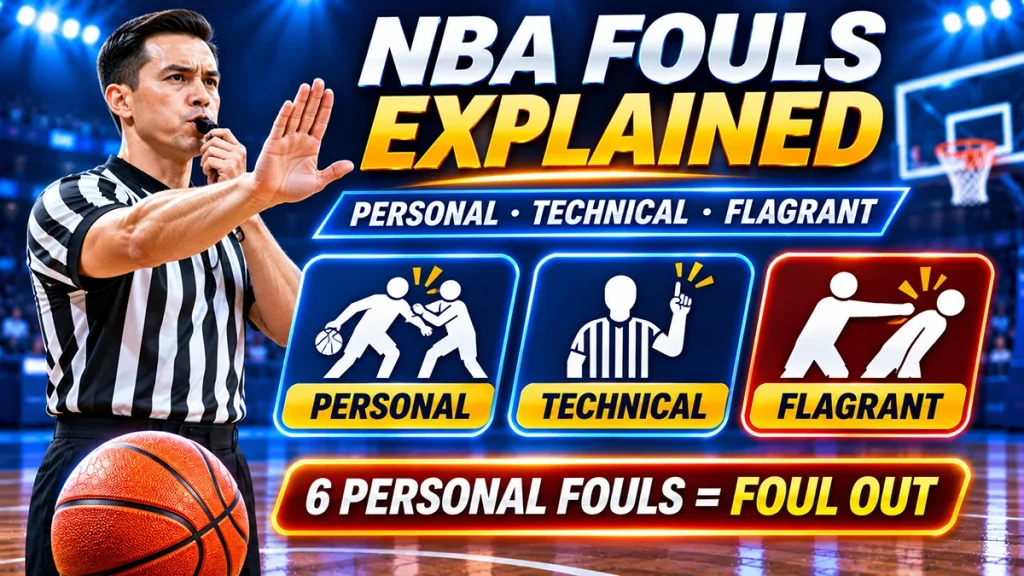
Why does one NBA foul result in two free throws, while another simply gives the opposing team possession? What happens when a player commits six fouls? And why can a single flagrant foul lead to an immediate ejection?
Understanding NBA fouls makes basketball much easier to follow, especially during close games when every whistle can affect the result.
Not all fouls carry the same penalty. Some involve illegal physical contact, others concern unsportsmanlike behaviour, and more serious incidents can lead to additional free throws or ejection.
At ArenaLive, we help basketball fans in the Philippines follow available NBA schedules, match scores and results in Philippine Time (PHT, UTC+8).
Here’s a practical guide to NBA foul rules, personal fouls, technical fouls, flagrant fouls and the team foul bonus.
What Are the Main Types of Fouls in the NBA?
NBA fouls can be classified according to the action involved and the applicable penalty.
The main categories fans should understand are personal, technical and flagrant fouls.
| Foul Type | Main Meaning | Typical Consequence |
|---|---|---|
| Personal Foul | Illegal physical contact | Possession or free throws |
| Technical Foul | Misconduct or certain rule infractions | Usually one free throw |
| Flagrant 1 | Unnecessary physical contact | Two free throws and possession |
| Flagrant 2 | Unnecessary and excessive contact | Two free throws, possession and ejection |
These are the standard outcomes for individual calls. Special situations, simultaneous fouls and other penalties can affect how play resumes.
The important thing to remember is that a referee’s whistle does not automatically mean the same punishment every time.
What Is a Personal Foul in the NBA?
A personal foul generally involves illegal contact between players.
Basketball allows physical competition, but players cannot use prohibited contact to gain an advantage over an opponent.
Common examples include:
- Holding an opponent.
- Pushing a player out of position.
- Illegally contacting a shooter’s arm.
- Blocking an opponent’s movement without establishing a legal defensive position.
- Making illegal contact while setting a screen.
Not every physical collision is a foul. Referees consider the players’ positioning, movements and the nature of the contact.
A personal foul can occur while a player is shooting, dribbling, defending, rebounding or moving without the ball.
How Many Fouls Are Allowed in an NBA Game?
An NBA player normally fouls out after receiving six personal fouls in the same game.
When a player reaches that limit, they must leave the game and be replaced by an eligible substitute.
Their team does not normally lose a player position on the court. Another player takes their place so the team can continue playing with five players.
Personal fouls accumulate throughout the game. They do not reset at halftime or at the beginning of another quarter.
There is an exceptional NBA provision for situations where no eligible substitutes remain and removing a player would leave the team with fewer than five players. Additional penalties apply in those rare circumstances.
What Does Foul Trouble Mean?
Foul trouble describes a situation where a player has accumulated enough fouls to risk being disqualified later in the game.
Imagine a starting center commits three personal fouls during the first quarter.
Their coach may temporarily substitute them to protect their availability for the second half.
A player with five fouls must be particularly careful. One more personal foul would normally end their participation in the game.
This is why foul totals can influence coaching decisions even when a player’s scoring performance is excellent.
What Is a Shooting Foul?
A shooting foul occurs when illegal defensive contact affects a player who is in the act of shooting.
The number of free throws depends on the type of shot and whether the basket is successful.
| Situation | Standard Outcome |
|---|---|
| Missed two-point attempt with a shooting foul | Two free throws |
| Missed three-point attempt with a shooting foul | Three free throws |
| Successful two-point shot with a shooting foul | Two points and one free throw |
| Successful three-point shot with a shooting foul | Three points and one free throw |
These examples describe ordinary defensive shooting fouls. More serious fouls may carry separate penalties.
What Does And-One Mean?
An and-one occurs when a player scores a basket despite being fouled during the shooting action and receives an additional free throw.
For example, a player makes a layup while being illegally contacted by a defender.
The two-point basket counts, and the player receives one free throw.
If the free throw is successful, the team scores three points from the play.
An and-one following a successful three-pointer can produce a four-point play.
What Is an Offensive Foul?
An offensive foul occurs when a player on the attacking team commits illegal contact.
Charging and illegal screens are common examples.
Charging vs Blocking
A charging foul can occur when an offensive player makes illegal contact with a defender who has established the required legal guarding position.
A blocking foul may instead be assessed against a defender who illegally obstructs the offensive player’s movement.
These decisions depend on timing, positioning and specific NBA rules, including the restricted area near the basket.
The fact that a defender falls to the floor does not automatically establish that a charge occurred.
Illegal Screens
A screen helps a teammate create space by legally obstructing a defender’s path.
However, a screener can commit a foul through prohibited movement or contact.
A typical offensive foul results in the attacking team losing possession. It also adds to the offending player’s personal foul count, but an ordinary offensive foul does not normally count towards the NBA team foul bonus or produce penalty free throws.
What Are Team Fouls and the NBA Bonus?
Personal fouls and team fouls are related, but they measure different things.
Personal fouls track an individual player’s foul total throughout the game.
Team fouls track the applicable fouls committed by the team during a particular quarter or overtime period.
Under NBA rules, once a team exceeds its team foul allowance, certain additional defensive fouls result in two free throws for the opponent.
This is commonly called being in the bonus.
How Many Team Fouls Before the Bonus?
During a regulation quarter, the general allowance is four team fouls.
The fifth qualifying team foul normally puts the opponent into a free-throw penalty situation.
In overtime, the general allowance is three team fouls, with the fourth qualifying team foul triggering the penalty.
There is also an important special rule during the final two minutes of each period.
If a team has not already used its foul allowance, it can generally commit only one additional qualifying foul during those final two minutes before the next such foul results in penalty free throws.
Example of the Bonus Rule
Imagine Team A has committed four team fouls in the fourth quarter.
A defender then commits another ordinary defensive foul against Team B.
Even if the offensive player is not shooting, Team B normally receives two free throws because the foul allowance has been exceeded.
This is why the same type of contact can lead to different outcomes earlier and later in a quarter.
All examples in this guide are hypothetical and do not represent actual NBA games.
What Is a Technical Foul in the NBA?
A technical foul often concerns behaviour or a specific procedural infraction rather than ordinary illegal contact during play.
Common reasons include:
- Unsportsmanlike conduct towards an official.
- Prohibited taunting.
- Excessive complaining or inappropriate gestures.
- Requesting a timeout when none remain.
- Certain administrative or game-procedure infractions.
A single technical foul ordinarily gives the opposing team one free throw.
However, technical foul penalties can differ in situations such as double technicals or fighting.
A technical foul does not automatically add one to the player’s personal foul total.
Do Two Technical Fouls Mean Ejection?
Two unsportsmanlike technical fouls assessed against the same participant in a game normally result in mandatory ejection.
An official can also eject someone for certain serious misconduct after a single incident.
However, not every type of technical foul is classified as unsportsmanlike conduct.
Therefore, fans should not assume that every combination of two technical fouls automatically has the same consequence.
What Is a Flagrant Foul in the NBA?
Flagrant fouls involve contact that meets more serious criteria than an ordinary personal foul.
The NBA uses two main levels: Flagrant 1 and Flagrant 2.
Flagrant 1
A Flagrant 1 involves contact judged to be unnecessary.
The standard penalty includes two free throws for the fouled team, followed by possession.
One Flagrant 1 does not automatically eject the offending player. However, a second flagrant foul in the same game results in ejection.
Flagrant 2
A Flagrant 2 involves contact judged to be both unnecessary and excessive.
The standard consequences include two free throws, possession for the fouled team and immediate ejection of the offending player.
A Flagrant 2 can end a player’s participation even if it is their first foul of the game.
Why Do Referees Review Flagrant Fouls?
Officials use instant replay to evaluate whether a foul meets the criteria for a flagrant classification.
The review can help determine the severity and nature of the contact.
A hard foul is not automatically a Flagrant 2. Officials must apply the relevant criteria to the actual incident.
Technical Foul vs Flagrant Foul: What’s the Difference?
The main distinction concerns the type of misconduct and the resulting penalty.
A technical foul often involves behaviour or a procedural rule violation.
A flagrant foul involves unnecessary or excessive physical contact.
A player arguing aggressively with an official might receive a technical foul.
A player making dangerous contact with an opponent might receive a flagrant foul, depending on the official review.
Flagrant fouls also count as personal and team fouls. Technical fouls generally do not count towards a player’s six-personal-foul limit.
Neither category should be confused with traveling or double dribble.
Our Traveling vs Double Dribble guide explains why those actions are violations rather than ordinary personal fouls.
How to Read NBA Fouls in a Box Score
When reviewing a basketball box score, you may see the abbreviation PF, meaning personal fouls.
This number helps explain why a player spent time on the bench or was unavailable late in the game.
For example, a player with five personal fouls may still participate, but faces disqualification after another personal foul.
Team foul indicators provide different information. They help explain whether the opponent is entitled to bonus free throws.
For a broader explanation of player statistics, read our NBA Box Score Explained guide.
Remember that a player’s PF total does not necessarily identify the exact type of every foul.
Detailed officiating or play-by-play information is needed to understand individual incidents.
How to Follow NBA Games on ArenaLive
You can find available fixtures, match statuses and confirmed scores through our NBA games and scores page.
Select a matchup to review its available game information.
Not every ArenaLive match page includes individual foul totals, bonus indicators or complete play-by-play statistics. Detailed coverage depends on the available sports data.
If a game includes several stoppages or free throws, its score and status alone may not explain which fouls were called.
For help understanding the different periods in a basketball game, our NBA Quarters Explained guide covers regulation time and overtime.
We display available basketball schedules in Philippine Time so local fans can follow their favourite teams without manually converting US tip-off times.
Frequently Asked Questions
How many personal fouls does it take to foul out in the NBA?
An NBA player normally fouls out after committing six personal fouls in the same game. Rare exceptions apply when a team has no eligible substitutes available.
What is the difference between Flagrant 1 and Flagrant 2?
Flagrant 1 involves unnecessary contact. Flagrant 2 involves unnecessary and excessive contact and requires immediate ejection.
Does a technical foul count as a personal foul?
Generally, no. An ordinary technical foul is tracked separately from the player’s personal foul total.
How many team fouls put an NBA team in the bonus?
The fifth qualifying team foul in a regulation quarter normally triggers the penalty. In overtime, it is generally the fourth. Special rules apply during the final two minutes of each period.
Does every NBA foul result in free throws?
No. Some fouls result in a throw-in or change of possession. Free throws depend on the type of foul, the shooting action, the team foul situation and any special penalties.
Understand NBA Fouls and Follow the Game
Personal fouls, technical fouls and flagrant fouls affect basketball in different ways.
Personal fouls can limit a player’s participation. Technical fouls can result from misconduct or specific rule infractions. Flagrant fouls carry more serious penalties, while team fouls influence whether opponents receive bonus free throws.
Understanding these differences helps explain why referees make different decisions after similar-looking incidents.
At ArenaLive, we help fans across the Philippines follow available NBA schedules, scores and confirmed results.
Know the rules, understand the whistle and enjoy basketball with ArenaLive.