An NBA player catches the ball, the scoreboard shows eight seconds, and suddenly the entire team starts moving faster.
Why?
Because the shot clock is running out.
The NBA shot clock limits how long a team can keep possession before attempting a qualifying shot. It helps prevent teams from holding the basketball indefinitely and encourages continuous offensive play.
But the rules involve more than simply counting down from 24.
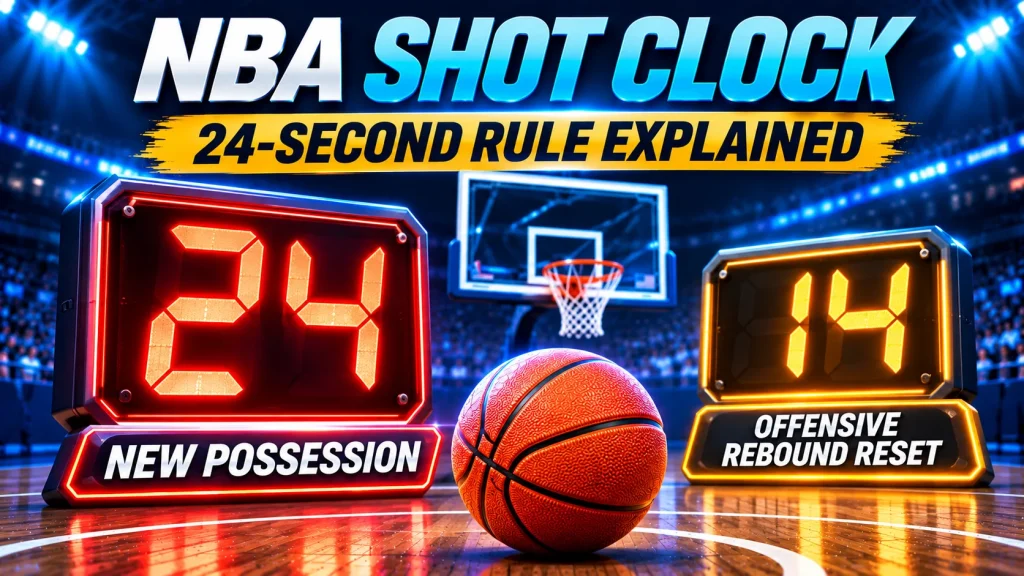
Sometimes the shot clock resets to 14 seconds. Sometimes it stays at its current time. And sometimes it doesn’t operate because the game itself is nearly over.
At ArenaLive, we help Filipino basketball fans follow available NBA schedules, match scores and results in Philippine Time (PHT, UTC+8).
Here’s how the NBA shot clock works, what causes a violation and why the 14-second reset is important.
What Is the Shot Clock in Basketball?
The shot clock is a countdown timer that limits the time available for a team’s offensive possession.
Under standard NBA rules, a team generally receives 24 seconds to attempt a qualifying field goal after gaining new possession.
During those seconds, players can dribble, pass, set screens and create scoring opportunities.
However, the attacking team cannot simply hold the basketball until the period ends.
It must make a legal shot attempt before the shot clock expires.
The clock helps maintain the pace of basketball and gives both teams opportunities to attack.
Where Is the Shot Clock Displayed?
In NBA games, the shot clock is displayed on timing equipment associated with the baskets.
Television broadcasts may also show a separate shot-clock countdown near the game clock.
This allows viewers to see how much time remains for the current possession.
When the shot clock approaches zero, the attacking team must act quickly to avoid losing possession.
Why Does the NBA Use a 24-Second Shot Clock?
The NBA adopted the 24-second shot clock in the 1954–55 season.
Before its introduction, teams could hold the basketball for extended periods.
This sometimes produced slow games in which one team deliberately avoided shooting.
The shot clock changed the pace of professional basketball by requiring teams to attempt shots within a limited time.
The 24-second limit remains a fundamental part of today’s NBA rules.
However, modern basketball also includes shorter resets in particular situations.
When Does the NBA Shot Clock Start?
The shot clock normally starts when a team establishes a new live-ball possession.
For example, after a defensive rebound, the team gaining possession generally receives a new 24-second count.
The same principle applies when a team steals the ball and gains possession.
For a throw-in, the shot clock starts when the ball is legally touched by a player on the court.
This is important because the clock does not necessarily begin when the inbounder receives the basketball from the referee.
The precise starting procedure depends on how possession begins.
What Happens When the Shot Clock Reaches Zero?
A shot clock violation occurs when a team fails to make a qualifying field-goal attempt within its allotted time.
The attacking team loses possession.
The opposing team receives the basketball for a throw-in according to NBA rules.
A shot clock violation is not automatically a personal foul.
It normally does not award free throws.
Does the Ball Need to Leave the Player’s Hand?
Yes.
For a legal attempt, the shooter must release the basketball before the shot clock expires.
Releasing the ball after the clock reaches zero is too late.
However, releasing the ball before the buzzer is only part of the requirement.
The shot must also satisfy the relevant basket-ring or successful-field-goal conditions.
Does the Basketball Have to Hit the Rim?
For an unsuccessful field-goal attempt to prevent a shot clock violation, the ball must contact the basket ring.
A successful basket released before the shot clock expires also counts.
Consider these examples.
Example 1: The ball hits the rim.
A player releases the shot before the buzzer, and the ball contacts the ring.
The attempt satisfies the relevant shot-clock requirement.
Example 2: The player makes the basket.
A player releases a shot before the shot clock expires, and the ball goes into the basket.
The successful field goal can count, even if the buzzer sounds while the ball is in the air.
Example 3: The shot misses everything.
A player releases the ball before the buzzer, but the attempt misses the basket ring and does not score.
If the shot clock expires without another qualifying event, a violation occurs.
This is why simply throwing the ball towards the basket is not always enough.
Does Hitting the Backboard Reset the Shot Clock?
Not by itself.
A shot that touches only the backboard does not satisfy the basket-ring requirement for an unsuccessful field-goal attempt.
The same applies when the ball misses both the backboard and ring.
These are often called airballs, although a ball may touch the backboard without being an airball.
If the attacking team retrieves a shot that never contacted the ring, it does not automatically receive a new 14-second clock.
The original shot-clock situation remains relevant.
That distinction is important when watching a rushed attempt near the end of a possession.
Why Does the NBA Shot Clock Reset to 14 Seconds?
The 14-second reset is one of the most useful NBA rules to understand.
In certain situations, the attacking team keeps possession but receives a shorter offensive clock.
The most familiar example is an offensive rebound.
Offensive Rebound Example
Imagine a player attempts a shot.
The basketball hits the rim but misses.
A teammate collects the offensive rebound.
Instead of receiving another full 24 seconds, the attacking team receives 14 seconds for its next possession sequence.
This rewards the team for recovering the ball while keeping the game moving.
The same reset can apply after certain missed free throws that remain in play.
Other Situations Involving a 14-Second Reset
NBA rules also provide for 14-second resets in specific situations immediately following unsuccessful attempts that satisfy the ring-contact requirements.
These can include certain defensive loose-ball fouls or situations where the offensive team retains possession after the ball goes out of bounds.
The exact reset depends on what happened and where play resumes.
The important point: Not every stoppage automatically resets the clock to 14 seconds.
When Does the Shot Clock Reset to 24 Seconds?
A new 24-second count normally applies when possession changes from one team to the other.
For example:
A team misses a shot.
The opposing team collects the defensive rebound.
The team that secured the rebound generally receives a new 24-second clock.
A similar reset normally follows a steal that establishes a new possession.
Some violations, fouls and other situations also require a 24-second reset under NBA rules.
The difference is whether the same attacking team continues possession or the opposing team has gained possession, together with any applicable exceptions.
Does Every Defensive Foul Reset the Shot Clock?
No.
The NBA uses different reset procedures depending on the foul, where the ball will be inbounded and the amount of time remaining.
For certain defensive fouls resulting in a frontcourt throw-in, the shot clock remains at its existing time or resets to 14 seconds, whichever is greater.
For example, imagine the attacking team has 18 seconds remaining when a qualifying defensive foul stops play.
In that situation, the clock may stay at 18 rather than being reduced to 14.
If only seven seconds remain, the applicable reset may increase the clock to 14.
However, different rules apply to other foul situations.
The correct decision depends on the circumstances, not simply whether the referee blew the whistle.
What Is the Difference Between the Game Clock and Shot Clock?
Basketball uses two separate timing systems.
| Clock | Main Purpose |
|---|---|
| Game Clock | Shows the time remaining in the current quarter |
| Shot Clock | Limits the time available for an offensive possession |
In the NBA, each regulation quarter contains 12 minutes of playing time.
The game clock counts down the remaining period time.
The shot clock normally gives the team in possession up to 24 seconds to attempt a qualifying shot.
For example:
Game clock: Q3 — 5:42
Shot clock: 08
This means five minutes and 42 seconds remain in the third quarter, while the attacking team has eight seconds remaining on its shot clock.
These numbers measure different things.
For a detailed explanation of NBA playing periods, read our NBA Quarters Explained guide.
What Happens to the Shot Clock Near the End of a Quarter?
There are special timing rules near the end of an NBA period.
When a new possession begins with 24 seconds or less remaining on the game clock, the shot clock generally does not operate for that new possession.
The game clock already provides the shorter time limit.
There are exceptions, including certain situations that require a 14-second reset.
This explains why viewers sometimes see the game clock counting down while the separate shot clock is no longer active.
It does not mean the timing equipment is necessarily broken.
The game is simply operating under the applicable end-of-period rules.
Shot Clock Violation vs Traveling: What’s the Difference?
Both violations can result in a change of possession, but they involve different rules.
A shot clock violation occurs when the attacking team fails to attempt a qualifying shot within the required time.
Traveling involves illegal foot movement while controlling the basketball.
A double dribble involves an illegal continuation or restart of a dribble.
These violations can happen during the same type of offensive possession, but they are not interchangeable.
Our Traveling vs Double Dribble guide explains the footwork and dribbling rules in more detail.
Why Is the Shot Clock Important for NBA Strategy?
The shot clock affects how teams organise their offence.
Early in a possession, players may use passes, screens and movement to create a good scoring opportunity.
As the clock decreases, the attacking team has less time to execute another play.
With only a few seconds remaining, the player holding the ball may need to attempt a difficult shot.
The defence can use this pressure to its advantage.
A successful defensive possession does not always require a steal or blocked shot.
Forcing the attacking team into a rushed attempt can also be valuable.
Meanwhile, offensive rebounds create additional opportunities, even though the team receives a shorter reset.
Understanding the clock helps explain why teams sometimes shoot quickly and at other times use more of the available possession time.
How to Follow NBA Games on ArenaLive
Understanding the shot clock makes NBA basketball easier to follow.
You can check available fixtures through our ArenaLive NBA games and scores page.
Select a matchup to review its reported match status, scheduled time and available score information.
Not every game page includes a live shot-clock countdown, possession-by-possession statistics or detailed officiating information.
The level of information depends on the sports data available for that particular event.
A LIVE status also does not automatically guarantee that a video stream is available.
At ArenaLive, we display verified match information and only identify eligible viewing options when the necessary source and access permissions are confirmed.
Game schedules are organised in Philippine Time (PHT, UTC+8).
Frequently Asked Questions
How many seconds are on the NBA shot clock?
The standard NBA shot clock is 24 seconds for a new possession, subject to specific reset and end-of-period rules.
Why does the shot clock reset to 14 seconds?
A 14-second reset commonly occurs when the attacking team regains possession after a missed shot that touches the rim. Other qualifying situations can also require a 14-second reset.
Does hitting the backboard reset the shot clock?
No. Backboard contact alone does not satisfy the basket-ring requirement for an unsuccessful shot attempt.
Is a shot clock violation a personal foul?
No. It is a violation that normally results in the opposing team receiving possession, not a personal foul charged to a player.
Can a basket count after the shot clock buzzer?
Yes. A basket can count when the ball was legally released before the shot clock expired and the applicable scoring conditions are satisfied.
Understand Every NBA Possession
The NBA shot clock is more than a countdown on the scoreboard.
It affects shot selection, offensive rebounds, defensive pressure and the pace of the game.
A standard possession normally begins with 24 seconds, while certain offensive rebounds and other situations produce a 14-second reset.
Understanding the difference between the shot clock and game clock also makes late-game basketball easier to follow.
At ArenaLive, we help fans across the Philippines check available NBA schedules, match scores and results in Philippine Time.
Follow the action, understand the clock and enjoy basketball with ArenaLive.