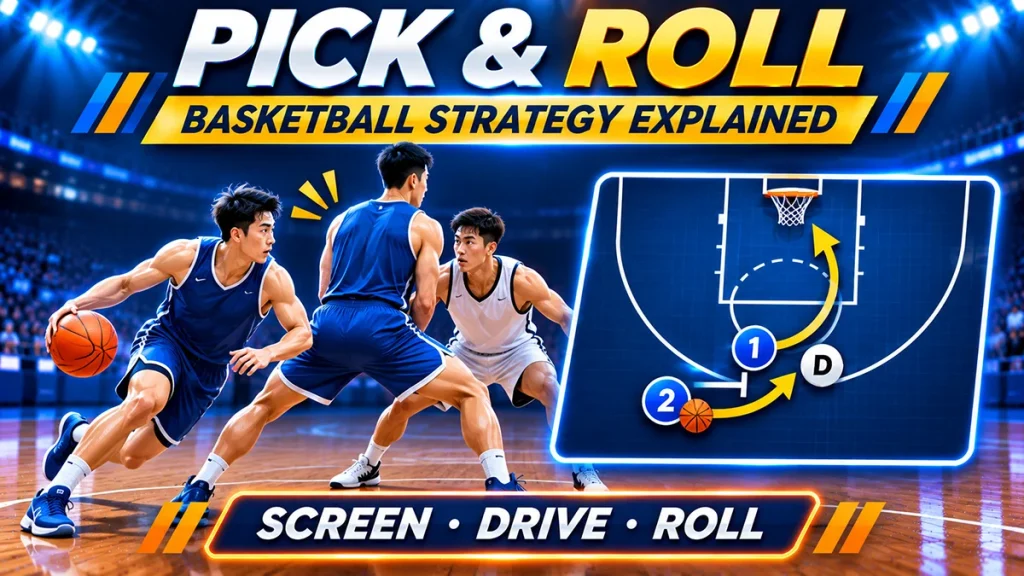
Watch an NBA or PBA game for a few minutes, and you’ll probably see a familiar sequence: one player dribbles around a teammate, a defender struggles to keep up, and the teammate cuts towards the basket.
This is often a pick and roll, one of the most widely used offensive actions in basketball.
It looks simple, but a well-executed pick and roll can create an open layup, a jump shot, a passing opportunity or a difficult decision for the opposing defense.
At ArenaLive, we help Filipino basketball fans follow available NBA, PBA and international basketball games.
In this guide, we’ll explain how the pick and roll works, what each player does and how teams defend against it.
What Is a Pick and Roll in Basketball?
A pick and roll is an offensive action involving two teammates: a ball handler and a screener.
The screener establishes a legal position that helps obstruct the ball handler’s defender. The ball handler uses the screen to create space, while the screener moves towards the basket to become a passing or scoring option.
The name describes two parts of the action:
- Pick: A teammate sets a screen for the player controlling the ball.
- Roll: The screener moves towards the basket after setting the screen.
The goal is to create an advantage against the defense.
Although the main action involves two offensive players, the positioning of the other three teammates also matters. Good spacing can make it harder for additional defenders to help.
How Does the Pick and Roll Work?
Let’s look at a basic example involving a point guard and a center.
Step 1: The Ball Handler Prepares the Play
The point guard controls the basketball near the perimeter.
The center moves towards the defender guarding the point guard.
The guard may change direction or adjust their dribble to encourage the defender to move towards the upcoming screen.
Step 2: The Screener Sets a Legal Screen
The center establishes a screening position.
A well-positioned screen can force the defender to take a longer route to stay with the ball handler.
The screener must follow the applicable rules regarding positioning, movement and contact.
Step 3: The Ball Handler Uses the Screen
The point guard dribbles around the screen, attempting to create separation from the original defender.
The guard now reads the positioning of the second defender.
Depending on how the defense reacts, the guard may drive, shoot or pass.
Step 4: The Screener Rolls Towards the Basket
After the screen, the center moves towards the basket.
This creates another scoring threat.
If the defense focuses too much on the ball handler, the rolling player may become available for a pass and a close-range finish.
The ball handler doesn’t have to pass to the roller every time. The best decision depends on the available space and defensive reaction.
Who Usually Runs the Pick and Roll?
A traditional pick and roll often involves a guard and a bigger player, such as a power forward or center.
The guard usually handles the ball, while the bigger player provides the screen and moves towards the basket.
However, any combination of players can perform the action.
A forward can initiate the pick and roll, and a guard can set a screen for a teammate.
Modern basketball frequently uses different combinations to create favorable matchups.
For more information about these roles, read our Basketball Positions Explained guide.
What Can the Ball Handler Do After Using a Screen?
A pick and roll creates several possible scoring opportunities. The ball handler needs to recognize which option is available rather than deciding on a pass before the defense reacts.
| Defensive Situation | Possible Offensive Response |
|---|---|
| The defender is delayed by the screen | Drive towards the basket |
| The second defender stays near the rim | Attempt an open pull-up shot |
| Both defenders focus on the ball | Pass to the rolling teammate |
| Another defender helps inside | Pass to an open perimeter shooter |
| The defenders switch assignments | Attack a favorable matchup |
These are tactical examples, not guaranteed outcomes.
A good pick and roll depends on timing, spacing and the abilities of the players involved.
Sometimes the first screen does not create an advantage. The team can reset the action, use another screen or move into a different play.
Pick and Roll vs Pick and Pop
The pick and pop is a variation of the traditional pick and roll.
Both actions begin with a screen, but the screener moves to a different area afterwards.
Pick and Roll
The screener cuts towards the basket, looking for a passing opportunity or close-range scoring chance.
This can be especially effective when the screener is a strong finisher around the rim.
Pick and Pop
Instead of cutting towards the basket, the screener moves into open shooting space.
The player may step towards the midrange area or beyond the three-point line.
A screener who can shoot from distance forces defenders to consider another scoring threat.
The main difference is simple: a roller moves towards the basket, while a popper moves towards open shooting space.
What Is a Short Roll in Basketball?
A short roll happens when the screener moves into an open area between the perimeter and the basket rather than continuing all the way to the rim.
This can be useful when two defenders pressure the ball handler.
The ball handler passes to the screener, who receives the ball in the middle of the court and makes the next decision.
The screener may attempt a short shot, drive towards the basket or pass to another teammate.
A successful short roll often requires good passing ability and quick decision-making from the screener.
It can turn pressure on the ball handler into an opportunity for the other offensive players.
How Do Teams Defend the Pick and Roll?
There is no single defensive strategy that works against every pick and roll.
Teams adjust their coverage depending on the opposing players, their own defensive personnel and the situation in the game.
Switching
When defenders switch, they exchange defensive assignments.
The original ball handler’s defender takes the screener, while the screener’s defender takes the ball handler.
This can prevent an immediate open driving lane, but it may create a mismatch.
For example, a smaller defender could end up guarding a taller center near the basket.
Drop Defense
In drop coverage, the screener’s defender stays closer to the basket instead of aggressively following the ball handler towards the perimeter.
This helps protect the rim and limit easy scoring opportunities inside.
However, the ball handler may find space for a pull-up jump shot if their original defender cannot recover quickly enough.
Hedge and Recover
A hedge occurs when the screener’s defender temporarily steps out to slow down or redirect the ball handler.
This gives the original defender time to recover.
The second defender then attempts to return to the screener.
Good communication and recovery timing are important because an aggressive hedge can leave the rolling player temporarily open.
Blitz or Trap
A blitz sends two defenders towards the ball handler, attempting to restrict dribbling and passing options.
The objective is to force a rushed decision or turnover.
However, committing two defenders to one player can create openings elsewhere.
The remaining defenders must rotate to cover the roller and other offensive threats.
What Makes a Basketball Screen Illegal?
A pick and roll begins with a screen, but the screen must be legal.
A screener cannot push, hold or improperly move into a defender’s path to prevent them from following the ball handler.
NBA rules also require screeners to provide appropriate space and time for an opponent to avoid contact in certain situations.
An illegal screen may occur when a player extends an arm or leg to obstruct an opponent or makes prohibited contact while moving into their path.
If an offensive foul is called, the attacking team normally loses possession.
The offending player also receives a personal foul.
Remember that not every collision with a screener is illegal. The officials must consider positioning, movement and the circumstances of the contact.
For a broader explanation, see our NBA Fouls Explained guide.
Why Is the Pick and Roll So Effective?
The pick and roll works because it asks defenders to make several decisions within a short amount of time.
Should they follow the ball handler around the screen, switch assignments, protect the basket or pressure the ball?
Each choice can create a different opening.
The other offensive players also influence the action. A shooter waiting in the corner can make it risky for a defender to help against the roller.
A strong finisher can draw attention towards the basket, while a skilled ball handler can take advantage of open space on the perimeter.
However, the play does not guarantee a basket. Poor spacing, an illegal screen or a difficult pass can prevent the offense from creating a good opportunity.
How to Recognize the Pick and Roll During an NBA Game
When following an NBA game, try paying attention to the players away from the basketball.
Look for a teammate moving towards the defender guarding the ball handler.
Then watch what happens after the screen.
Does the screener cut towards the basket or move outside for a shot? Do the defenders exchange assignments? Does another defender leave a shooter to help inside?
These details explain why the ball handler chooses to shoot, drive or pass.
You can find available matchups through our ArenaLive NBA games and scores page. Our listings show available game schedules, reported statuses and confirmed scores in Philippine Time (PHT, UTC+8).
A final score alone cannot tell you how many pick and rolls a team used or how successfully it executed them. Detailed tactical analysis requires additional game information or footage.
Frequently Asked Questions
What does pick and roll mean in basketball?
It is an offensive action in which a teammate sets a screen for the ball handler and then moves towards the basket to create another scoring opportunity.
What is the difference between pick and roll and pick and pop?
In a pick and roll, the screener moves towards the basket. In a pick and pop, the screener moves into open shooting space instead.
Who usually sets the screen in a pick and roll?
Centers and power forwards commonly set screens, but any player can perform the role if the action follows the applicable basketball rules.
What does switching mean in pick and roll defense?
Switching means the two defenders exchange their assignments after the screen. This can limit immediate separation but may create a mismatch.
Is a moving screen always a foul?
Not every movement by a screener is automatically illegal. The ruling depends on positioning, the defender’s movement and whether prohibited contact occurs.
Understand the Teamwork Behind the Score
The pick and roll is more than a simple screen followed by a pass.
It creates a series of decisions for both the offense and the defense. The ball handler reads the available space, the screener becomes a scoring threat, and the other players help create opportunities through their positioning.
Once you understand rolling, popping, switching and drop defense, you’ll start noticing these patterns in NBA, PBA and international basketball games.
At ArenaLive, we help fans across the Philippines keep up with available basketball schedules, scores and results in Philippine Time.
Follow the game, recognize the tactics and discover the teamwork behind every scoring opportunity.