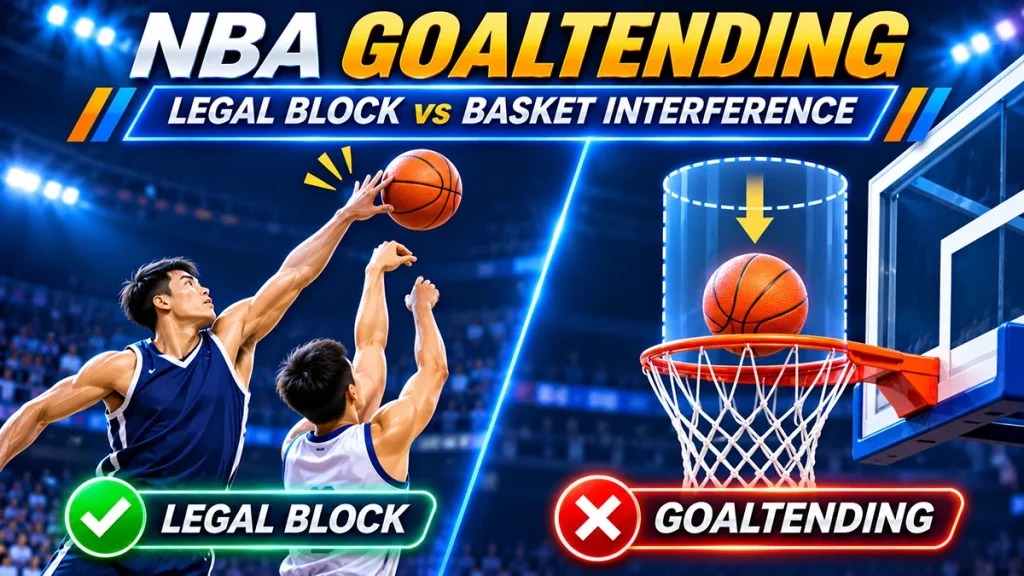
A basketball player drives towards the basket, releases a layup, and a defender jumps high to knock the ball away.
The crowd celebrates what looks like a spectacular block. But the referee blows the whistle and awards points to the attacking team.
What happened?
The defender may have committed goaltending.
Goaltending is one of the most interesting basketball violations because the difference between an excellent defensive play and an illegal one can come down to timing, ball position and whether the shot still has a chance to score.
At ArenaLive, we help Filipino basketball fans follow available NBA schedules, scores and results in Philippine Time (PHT, UTC+8).
Here’s how NBA goaltending rules work, how to distinguish legal blocks from violations, and why offensive players must also follow basket interference rules.
What Is Goaltending in Basketball?
Goaltending is a violation involving illegal interference with a basketball that is on its way towards the basket or is otherwise protected by the rules.
One common example occurs when a defender touches a shot after it has started descending towards the basket and can still go in.
The defender may have jumped high enough to reach the ball, but the timing of the contact makes the play illegal.
Under NBA rules, a player cannot simply remove a potential scoring attempt whenever the ball is within reach.
Several restrictions protect shots as they approach the basket.
These restrictions involve the ball’s flight, its position relative to the rim and whether it has touched the backboard.
Legal Block vs Goaltending: What Is the Difference?
A legal block prevents or changes an opponent’s shot without violating basketball rules.
Goaltending occurs when the player interferes with the ball during a protected part of the scoring attempt.
Here is a quick comparison.
| Situation | General NBA Ruling |
|---|---|
| Defender blocks a rising shot outside the protected area | Legal block, provided no foul occurs |
| Defender touches a descending shot that can still score | Goaltending |
| Defender knocks the ball away from directly above the rim | Goaltending or basket interference |
| Defender touches a viable shot after it hits the backboard above rim level | Goaltending |
| Offensive player touches a protected shot near the basket | Offensive basket interference |
These examples describe common situations. Officials must also consider the exact position of the ball and any applicable exceptions.
The simplest distinction is that a legal block stops a shot before the relevant restrictions apply, while goaltending interferes with a protected scoring opportunity.
When Is a Basketball Block Legal?
A defender can legally block a shot while the ball is still rising, provided the other restrictions have not been triggered and there is no illegal contact with the shooter.
For example, imagine a player attempts a jump shot from the free-throw line.
A defender jumps and deflects the ball shortly after its release, while it is still travelling upwards.
This can be a legal block.
A defender can also block certain layup or dunk attempts before the ball enters a protected position.
However, the fact that a ball is travelling upwards does not automatically make every block legal.
If the ball has already contacted the backboard in a protected situation or has entered the imaginary area directly above the rim, additional restrictions apply.
This is why officials consider more than whether the ball is moving upwards or downwards.
What Is the NBA Cylinder Rule?
Imagine an invisible vertical cylinder extending upwards from the basketball rim.
Its boundaries follow the area inside the rim.
This is commonly called the cylinder.
NBA basket interference rules generally prohibit players from touching the ball while it is above the rim and inside this imaginary cylinder.
The restriction can apply to defenders and offensive players.
Why Does the Cylinder Matter?
Imagine a shot bounces off the rim and moves directly above the basket.
A defender reaches up and knocks the ball away before it can drop through.
That can be a violation even though the shot has already contacted the rim.
Similarly, an offensive player cannot simply reach into the protected area and push a teammate’s shot into the basket.
The NBA does provide a specific exception involving legal contact that continues as a player near their own attacking basket moves the ball into the cylinder. A normal dunk is therefore not automatically basket interference.
The important distinction is how and when the player contacts the ball.
Can You Block the Ball After It Hits the Backboard?
This is one of the most frequently misunderstood goaltending situations.
Under NBA rules, a field-goal attempt that still has an opportunity to score becomes protected after contacting the backboard above rim level.
A defender cannot then legally knock it away simply because the ball is still moving upwards.
For example, a player releases a layup against the upper part of the backboard.
The ball is travelling towards the basket when a defender swats it away.
That can be goaltending.
There are also restrictions involving shots that contact the backboard below the rim while travelling upwards.
What About Chase-Down Blocks?
A chase-down block happens when a defender runs back towards their basket and catches up with an opponent attempting to score.
These plays can be spectacular, but the same goaltending rules apply.
A defender who reaches the ball before the relevant protection begins may complete a legal block.
If the shot has already entered a protected phase, the official may call goaltending instead.
A defender’s jumping ability or speed does not change the applicable rule.
Can You Touch the Ball After It Hits the Rim?
Sometimes, but not in every situation.
A common misconception is that touching the rim automatically makes a basketball available for any player to collect.
NBA rules are more specific.
A ball can remain protected while resting on the rim or bouncing above it inside the imaginary cylinder.
However, when the ball rolls off the outer edge of the rim and is no longer in a protected position, a player may be able to collect or redirect it legally.
This distinction matters during offensive rebounds and put-back attempts.
For example, a center can legally collect a missed shot that rebounds away from the basket and then attempt another shot.
But reaching into the cylinder to redirect a protected ball can result in basket interference.
What Is Offensive Basket Interference?
Goaltending is often discussed as a defensive violation, but offensive players must also respect the rules around the basket.
Offensive basket interference occurs when a player illegally interferes with their own team’s potential scoring attempt or otherwise violates the basket interference restrictions.
Consider a hypothetical example.
A player attempts a jump shot. The ball is descending towards the basket and still has a chance to score.
A teammate jumps and tips the ball into the basket before it has left the protected area.
Although the teammate is trying to help their own team score, the action may be illegal.
The basket can be disallowed, and possession awarded to the opposing team.
Are Put-Back Dunks Illegal?
No.
A put-back dunk can be perfectly legal when a player gains control of an available rebound and scores without interfering with a protected ball.
The difference is whether the original shot is still protected and when the offensive player makes contact.
A successful put-back is not automatically basket interference just because it happens close to the rim.
What Happens After a Goaltending Violation?
The consequences depend on which team commits the violation.
Defensive Goaltending
When a defender illegally interferes with an ordinary field-goal attempt, the attacking team is awarded the points associated with that attempt.
A two-point attempt results in two awarded points.
A three-point attempt results in three awarded points.
The ball does not need to pass through the basket after the illegal contact for those points to be awarded.
Offensive Basket Interference
When the attacking team commits the violation, the affected basket does not count.
The opposing team receives possession according to the applicable throw-in procedure.
This is why offensive players must be careful when attempting tips and put-back baskets.
Does Goaltending Count as a Personal Foul?
An ordinary goaltending violation on a field-goal attempt is a violation, not a personal foul.
However, separate foul rules can apply when another illegal action occurs during the same play. Interference with free throws can also involve additional penalties.
The result depends on the specific circumstances.
For a comparison with other common basketball violations, read our Traveling vs Double Dribble guide.
Why Can Two Similar Blocks Receive Different Calls?
Basketball moves quickly, especially when players jump to contest shots around the basket.
Two blocks that look nearly identical at normal speed may occur at different moments in the shot’s flight.
When trying to understand a goaltending decision, consider three questions:
- Was the ball still rising, or had it started descending towards the basket?
- Had it already touched the backboard in a protected situation?
- Was the ball above the rim and inside the imaginary cylinder?
The answers can help explain why one block is legal while another results in awarded points.
Officials may also use authorised replay procedures in certain situations, depending on the applicable NBA review rules.
Not every disputed block automatically receives a video review.
How to Recognise Goaltending When Following NBA Games
A goaltending call can affect the scoreboard even if a shot never goes through the basket.
For example, imagine Team A attempts a three-pointer that is illegally blocked during its protected flight.
If defensive goaltending is called, Team A can receive three points.
A fan checking the scoreboard may see the score increase without knowing why the points were awarded.
At ArenaLive, our NBA games and scores page helps you find available fixtures, match statuses and confirmed results.
However, a match score alone does not always explain the officiating decision behind each scoring play.
Not every game page includes detailed play-by-play information or video of individual calls.
If you’re learning to interpret basketball statistics, our NBA Box Score Explained guide introduces blocks, points and other common statistical categories.
Understanding the difference between a legal block and goaltending gives those numbers additional context.
Frequently Asked Questions
What is goaltending in the NBA?
Goaltending is a violation involving illegal interference with a protected scoring attempt or ball position near the basket. A common example is touching a descending shot that can still score.
Can you block a shot after it hits the backboard?
NBA rules prohibit contact with a viable shot after it has touched the backboard above rim level. The ball can be protected even if it is still rising.
Can an offensive player commit goaltending?
Yes. Offensive players can commit basket interference by illegally touching a protected ball, such as a teammate’s shot above the rim.
Does defensive goaltending count as two or three points?
It depends on the original field-goal attempt. A defensive violation on a two-point attempt results in two awarded points, while one on a three-point attempt results in three.
Can a basketball player legally block a dunk?
Yes, provided the defender contacts the ball legally before the relevant goaltending restrictions apply and does not commit a separate foul.
Understand the Difference Between a Block and Goaltending
A spectacular defensive play is not always a legal one.
NBA goaltending rules protect scoring attempts during specific parts of their flight and around the basket. The backboard, rim and imaginary cylinder all play an important role in determining whether contact with the ball is permitted.
Offensive players must follow these restrictions as well.
Once you understand these principles, it becomes easier to recognise why a referee awards points, cancels a basket or allows a defensive block.
At ArenaLive, we help basketball fans across the Philippines follow available NBA fixtures, scores and results in Philippine Time.
Know the rules, understand the calls and enjoy basketball with ArenaLive.