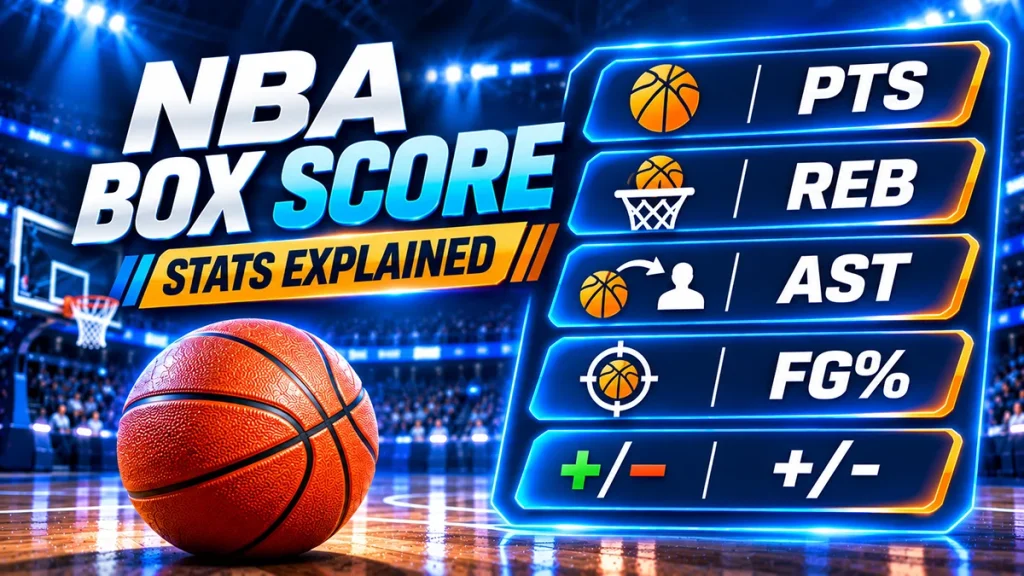
Ever checked an NBA game and seen numbers such as 28 PTS, 10 REB and 7 AST beside a player’s name?
These abbreviations are part of a basketball box score. They help explain what happened during a game and how individual players contributed to their teams.
A final score tells you who won. A box score helps you understand how the players performed.
From scoring and shooting percentages to rebounds, assists and turnovers, NBA statistics provide useful information beyond the scoreboard.
At ArenaLive, we help basketball fans in the Philippines follow available NBA schedules, match scores and results in Philippine Time (PHT, UTC+8).
In this guide, we’ll explain the most common NBA box score abbreviations, show you how to calculate important statistics and help you understand what the numbers actually mean.
What Is an NBA Box Score?
An NBA box score is a statistical summary of a basketball game.
It records individual and team performance across different categories.
A standard NBA box score includes information such as:
- Points scored
- Minutes played
- Field goals made and attempted
- Three-point shooting
- Free throws
- Rebounds
- Assists
- Steals
- Blocks
- Turnovers
- Personal fouls
- Plus-minus
The statistics are organised by team and player.
This allows fans to compare performances without watching every minute of the game.
For example, two players might each score 20 points, but one may have collected more rebounds while the other provided more assists.
Their point totals are identical, yet their contributions are different.
That’s why understanding basketball statistics is helpful when reviewing NBA results.
NBA Box Score Abbreviations Explained
Here are the most common statistics you’ll encounter in an NBA box score.
| Abbreviation | Meaning | What It Measures |
|---|---|---|
| MIN | Minutes | Time played |
| PTS | Points | Total points scored |
| REB | Rebounds | Total rebounds collected |
| AST | Assists | Passes credited with setting up made baskets |
| FG | Field Goals | Shots made and attempted, excluding free throws |
| FG% | Field Goal Percentage | Percentage of field-goal attempts made |
| 3PM | Three-Pointers Made | Successful three-point shots |
| 3PA | Three-Pointers Attempted | Three-point shots attempted |
| 3P% | Three-Point Percentage | Accuracy from three-point range |
| FTM | Free Throws Made | Successful free throws |
| FTA | Free Throws Attempted | Free throws attempted |
| FT% | Free Throw Percentage | Free-throw accuracy |
| OREB | Offensive Rebounds | Rebounds collected by the attacking team |
| DREB | Defensive Rebounds | Rebounds collected by the defending team |
| STL | Steals | Possessions taken from opponents and credited as steals |
| BLK | Blocks | Opponent shot attempts legally blocked |
| TOV | Turnovers | Times possession is lost |
| PF | Personal Fouls | Personal fouls committed |
| +/- | Plus-Minus | Team scoring margin while a player is on the court |
Some websites use slightly different abbreviations.
For example, turnovers may appear as TO or TOV, while three-point shooting may be labelled 3PT or 3P.
The underlying statistical categories are generally the same.
What Does PTS Mean in Basketball?
PTS stands for points.
It represents the total points scored by a player during a game.
In NBA basketball, points can come from:
- Free throws worth one point
- Two-point field goals
- Three-point field goals
Imagine a player makes five two-point shots, three three-pointers and four free throws.
Their scoring total would be:
Five two-point baskets = 10 points
Three three-pointers = 9 points
Four free throws = 4 points
Total: 23 PTS
This is a hypothetical example, not a real player’s game statistics.
Points are one of the easiest basketball statistics to understand, but they don’t tell the entire story.
A player can contribute significantly through passing, rebounding and defending even without scoring many points.
What Does REB Mean in an NBA Box Score?
REB stands for rebounds.
A rebound occurs when a player gains control of the ball after a missed shot or certain other missed scoring attempts.
Rebounds are divided into two main categories.
Offensive Rebounds — OREB
An offensive rebound happens when the attacking team regains possession after a missed scoring attempt.
This can create another opportunity to score.
For example, if a player misses a shot but a teammate collects the rebound, the attacking team may continue the possession.
Defensive Rebounds — DREB
A defensive rebound occurs when the defending team collects the ball after the opposing team misses.
This often allows the team to begin its next offensive possession.
Total rebounds are calculated by adding offensive and defensive rebounds.
REB = OREB + DREB
If a player collects two offensive rebounds and seven defensive rebounds, their total is nine rebounds.
Rebounding statistics are useful for understanding a player’s activity around the basket and contribution to securing possession.
What Does AST Mean in Basketball?
AST stands for assists.
An assist is credited when a player’s pass directly contributes to a teammate’s successful field goal under the applicable statistical guidelines.
For example, a player passes to a teammate who immediately makes a three-pointer.
The passer may receive an assist.
Assists are particularly important when evaluating playmakers.
Point guards often record assists because they frequently organise their team’s offence, although players at any position can earn them.
A player with 10 assists has helped create multiple scoring opportunities.
However, assists do not measure every good pass.
A teammate might miss an open shot after receiving an excellent pass, meaning no assist is recorded.
Therefore, assist totals should be considered alongside other information when evaluating passing ability.
What Do FG, FGM, FGA and FG% Mean?
Field-goal statistics measure shooting from the court, excluding free throws.
The main abbreviations are:
FGM: Field Goals Made
FGA: Field Goals Attempted
FG%: Field Goal Percentage
Field-goal percentage is calculated using this formula:
FG% = FGM ÷ FGA × 100
For example, suppose a player attempts 16 field goals and makes eight.
The calculation is:
8 ÷ 16 × 100 = 50%
Their FG% is 50%.
A common misunderstanding is that field goals only refer to two-point shots.
In basketball statistics, field goals include both successful two-point and three-point attempts.
Free throws are recorded separately.
This distinction becomes important when calculating a player’s total points.
What Do 3PT, 3PM and 3P% Mean?
Three-point statistics measure shooting from beyond the three-point line.
Common abbreviations include:
3PM: Three-Pointers Made
3PA: Three-Pointers Attempted
3P%: Three-Point Shooting Percentage
The formula is:
3P% = 3PM ÷ 3PA × 100
Imagine a player makes three of seven three-point attempts.
Their three-point percentage is approximately 42.9%.
A box score might display this as:
3PT: 3–7
3P%: 42.9%
Remember that successful three-pointers also count towards the player’s total field goals made.
They are not additional field goals added on top of the overall FG total.
This is an important detail when reading shooting statistics.
How Do Free-Throw Statistics Work?
Free throws are recorded separately from regular field-goal attempts.
The most common abbreviations are:
FTM: Free Throws Made
FTA: Free Throws Attempted
FT%: Free Throw Percentage
The formula is:
FT% = FTM ÷ FTA × 100
If a player makes four of five free throws, their free-throw percentage is 80%.
Each successful free throw adds one point to the player’s scoring total.
A player can therefore score efficiently from the free-throw line even when their regular field-goal percentage is relatively low.
What Do STL, BLK, TOV and PF Mean?
These categories help explain parts of the game beyond scoring.
STL — Steals
A steal is credited when a defender legally takes possession from an opponent in a way that results in a turnover.
Steals can create fast-break opportunities.
BLK — Blocks
A block is credited when a defender legally deflects an opponent’s field-goal attempt.
Blocks are one indicator of defensive activity, but they don’t capture every successful defensive play.
TOV — Turnovers
Turnovers occur when a team loses possession without completing its intended offensive opportunity.
Examples include travelling violations, intercepted passes and offensive fouls.
A high turnover total can indicate difficulty protecting possession.
However, the number should be interpreted alongside playing time and the player’s offensive responsibilities.
PF — Personal Fouls
PF records the number of personal fouls committed.
Under normal NBA rules, a player is disqualified upon reaching six personal fouls, subject to exceptional minimum-player provisions.
Fouls are important because they can influence playing time, defensive decisions and substitutions.
What Does Plus-Minus (+/-) Mean in the NBA?
Plus-minus is one of the most commonly misunderstood box score statistics.
It measures the difference between the points scored by a player’s team and the points scored by the opposing team while that player is on the court.
For example:
A player’s team scores 40 points during their minutes.
The opponent scores 32 points during those same minutes.
The player’s plus-minus is:
+8
If the opponent instead outscores the player’s team by six points during their minutes, the result is:
−6
A positive plus-minus means the player’s team outscored the opponent during that player’s time on the floor.
A negative plus-minus means the reverse.
However, plus-minus does not prove that one player personally caused the entire scoring difference.
It also reflects the teammates, opponents and game situations present during those minutes.
That’s why a single-game plus-minus should not be treated as a complete measure of player quality.
Example: How to Read a Complete NBA Box Score
Let’s combine the statistics into one hypothetical performance.
| Statistic | Example |
|---|---|
| MIN | 32:15 |
| FG | 8–16 |
| 3PT | 3–7 |
| FT | 4–5 |
| OREB | 2 |
| DREB | 7 |
| REB | 9 |
| AST | 6 |
| STL | 1 |
| BLK | 2 |
| TOV | 3 |
| PF | 4 |
| PTS | 23 |
| +/- | +8 |
These are illustrative statistics, not an actual NBA player or game.
Here’s what the numbers tell us.
The player spent 32 minutes and 15 seconds on the court.
They made eight of 16 field-goal attempts, including three successful three-pointers.
They also made four free throws.
Their scoring total is 23 points.
The player collected nine rebounds, assisted on six successful baskets, recorded one steal and blocked two shots.
They committed three turnovers and four personal fouls.
During their minutes, their team outscored the opponent by eight points.
This example shows why a box score provides more information than points alone.
What Is a Double-Double or Triple-Double?
You may also hear commentators describe a player recording a double-double or triple-double.
These terms refer to reaching double figures in multiple statistical categories.
Double-Double
A double-double occurs when a player records at least 10 in two of the following five categories:
Points, rebounds, assists, steals or blocks.
For example:
22 PTS, 12 REB
That is a double-double.
Triple-Double
A triple-double occurs when a player reaches at least 10 in three of those categories.
For example:
18 PTS, 11 REB, 10 AST
That is a triple-double.
These achievements highlight versatility, although individual statistics still need context.
A triple-double does not automatically mean the player was the best performer in a particular game.
How to Follow NBA Games on ArenaLive
Understanding statistics makes it easier to follow NBA basketball.
For available match schedules, statuses and scores, visit our ArenaLive NBA games page.
You can select an available matchup to review its reported game information.
The amount of statistical detail can vary between events and data providers.
Not every ArenaLive match page includes a complete player box score.
If detailed statistics are unavailable, use the verified match information shown rather than assuming missing categories have zero values.
For help understanding the difference between scheduled, live and completed fixtures, read our ArenaLive Match Scores guide.
If you want to understand the game clock and playing periods, our NBA Quarters Explained guide covers those topics separately.
Frequently Asked Questions
What does PTS mean in an NBA box score?
PTS means points. It records the total number of points a player scores through field goals and free throws during a game.
What is the difference between REB and AST?
REB measures rebounds collected after missed scoring attempts. AST measures assists credited for passes that lead directly to successful field goals.
What does FG% mean in NBA basketball?
FG% means field-goal percentage. It is calculated by dividing made field goals by attempted field goals and multiplying by 100.
What does +/- mean in a basketball box score?
Plus-minus measures the team’s scoring difference while a particular player is on the court. A positive number means their team outscored the opposition during those minutes.
Why are some NBA player statistics missing?
Statistical availability depends on the competition, source and level of coverage. A missing statistic should not automatically be interpreted as zero.
Understand the Numbers Behind Every NBA Game
An NBA box score provides a deeper look at basketball performance.
PTS explains scoring. REB measures rebounding. AST highlights credited assists. FG% and 3P% describe shooting accuracy, while turnovers, blocks, steals and plus-minus provide additional context.
No single statistic tells the complete story.
By reading these numbers together, you can better understand how players contribute throughout a basketball game.
At ArenaLive, we help fans across the Philippines follow available NBA schedules, scores and results in Philippine Time.
Use the scoreboard to find out what happened, and apply your knowledge of basketball statistics to better understand the game.