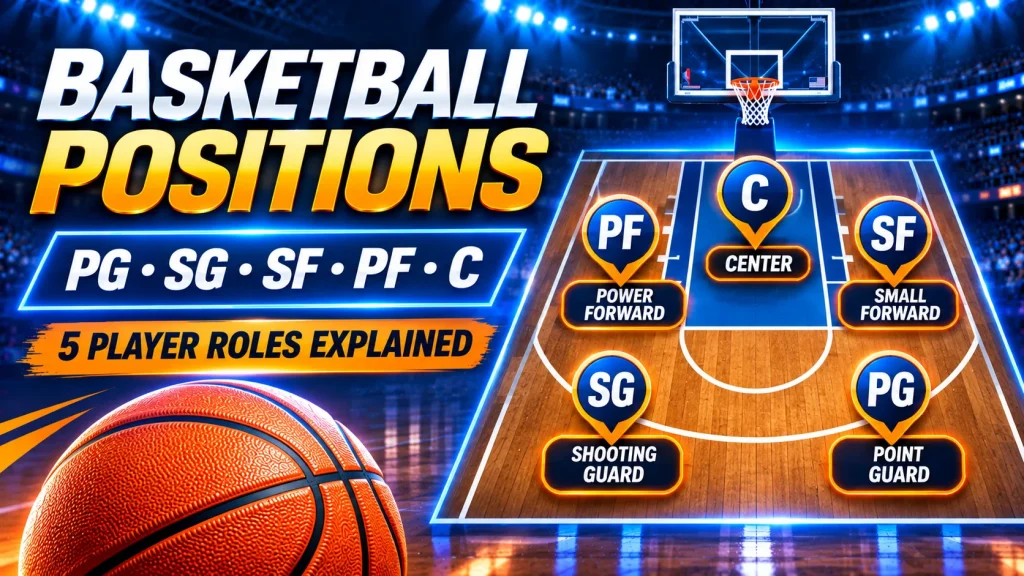
What does PG mean in basketball? Why do some players have SG or SF beside their names? And what’s the difference between a power forward and a center?
If you’re new to basketball, these abbreviations can be confusing.
Every traditional basketball lineup has five positions: point guard, shooting guard, small forward, power forward and center.
Each position has its own responsibilities, but modern basketball is much more flexible than it used to be.
A center can make three-pointers. A forward can lead the team in assists. And a point guard can become the team’s leading scorer.
At ArenaLive, we help Filipino basketball fans follow available NBA, PBA and international basketball games.
In this guide, we’ll explain the five basketball positions, their main responsibilities and how to recognise different player roles during a game.
What Are the Five Positions in Basketball?
The five traditional basketball positions are:
| Number | Abbreviation | Position | Traditional Main Role |
|---|---|---|---|
| 1 | PG | Point Guard | Organises the offence |
| 2 | SG | Shooting Guard | Perimeter scoring |
| 3 | SF | Small Forward | Versatile scoring and defence |
| 4 | PF | Power Forward | Rebounding and inside play |
| 5 | C | Center | Interior defence and rebounding |
These positions describe player roles rather than five fixed locations on the court.
A traditional lineup usually includes two guards, two forwards and one center.
However, basketball rules do not require a team to use exactly one player from each position.
Coaches can choose different combinations depending on their strategy, available players and the opposing team.
Understanding the traditional positions provides a useful starting point for recognising what different players do.
1. Point Guard (PG): The Floor General
PG stands for Point Guard.
The point guard is traditionally responsible for organising the team’s offence.
This player often brings the ball up the court and decides how an attacking possession begins.
A point guard needs strong ball-handling skills, court awareness and passing ability.
What Does a Point Guard Do?
Common responsibilities include:
- Bringing the ball into the offensive half.
- Initiating offensive plays.
- Passing to teammates in scoring positions.
- Controlling the pace of the offence.
- Recognising defensive pressure.
- Creating scoring opportunities.
A point guard is often described as the team’s floor general because the role involves making decisions while the game is moving.
However, not every point guard is primarily a passer.
Modern point guards can also be excellent shooters and aggressive scorers.
What Statistics Matter for a Point Guard?
Assists, turnovers and shooting efficiency can provide useful information.
Assists help show how often a player creates successful scoring opportunities through passing.
Turnovers show how frequently a player loses possession.
Neither statistic tells the full story, but both help explain the point guard’s performance.
2. Shooting Guard (SG): The Perimeter Scorer
SG stands for Shooting Guard.
The shooting guard is traditionally one of the team’s main scoring threats.
This position is commonly associated with outside shooting, especially three-point attempts.
However, shooting guards don’t only stand behind the three-point line.
They may also attack the basket, create shots off the dribble and contribute to ball movement.
What Does a Shooting Guard Do?
Typical responsibilities include:
- Shooting from the perimeter.
- Moving without the ball to find open space.
- Attacking the basket.
- Creating scoring opportunities.
- Supporting the point guard.
- Defending opposing perimeter players.
A shooting guard who moves well without the ball can be effective even when they aren’t handling it.
Defenders must pay attention to where that player moves because open shooting opportunities can develop quickly.
Point Guard vs Shooting Guard
The simplest traditional distinction is:
PG: Primarily organises the offence.
SG: Primarily looks for scoring opportunities.
In modern basketball, these responsibilities often overlap.
Some shooting guards regularly initiate plays, while some point guards lead their teams in scoring.
The distinction depends more on the player’s actual responsibilities than the position abbreviation alone.
3. Small Forward (SF): The Versatile Wing
SF stands for Small Forward.
Small forwards are often among the most versatile players on a basketball team.
They combine elements of guard and forward play.
A small forward may shoot from long range, attack the basket, collect rebounds and defend different types of opponents.
What Does a Small Forward Do?
Common responsibilities include:
- Scoring from inside and outside.
- Driving towards the basket.
- Defending perimeter players.
- Helping collect rebounds.
- Moving between different offensive positions.
- Supporting teammates through passing and screening.
Small forwards are often called wings because they frequently operate around the sides of the court.
However, they are not restricted to those areas.
A small forward can move into the paint, handle the ball or set up teammates when the offensive system requires it.
What Makes a Good Small Forward?
Versatility is particularly valuable.
A player who can shoot, defend, rebound and make decisions with the ball gives the coach several tactical options.
This is one reason the small forward role has become increasingly flexible in modern basketball.
4. Power Forward (PF): Strength and Versatility
PF stands for Power Forward.
The power forward traditionally operates closer to the basket than the smaller perimeter players.
Power forwards often combine physical strength, rebounding and interior scoring.
However, the position has changed significantly.
Many modern power forwards can also shoot from long distance and help space the floor.
What Does a Power Forward Do?
Traditional responsibilities include:
- Rebounding missed shots.
- Defending taller opponents.
- Scoring near the basket.
- Setting screens for teammates.
- Helping protect the painted area.
- Creating space for offensive possessions.
A power forward can also contribute from the perimeter.
What Is a Stretch Four?
A stretch four is a power forward who can shoot effectively from longer distances, particularly beyond the three-point line.
The term comes from the traditional position number four.
By moving away from the basket, a stretch four can pull a defender out of the paint.
This may create additional driving space for teammates.
Not every power forward is a stretch four, and shooting is only one part of the position.
5. Center (C): The Interior Presence
C stands for Center.
The center is traditionally the team’s biggest player and often operates around the basket.
Centers are commonly associated with rebounding, rim protection and close-range scoring.
A center can have a major influence on both offence and defence.
What Does a Center Do?
Typical responsibilities include:
- Protecting the basket.
- Contesting shots near the rim.
- Collecting defensive rebounds.
- Securing offensive rebounds.
- Setting screens.
- Scoring around the basket.
- Defending opposing interior players.
A center’s defensive contribution goes beyond blocked shots.
Simply positioning themselves well can make opponents take more difficult attempts.
Can a Center Shoot Three-Pointers?
Yes.
Modern centers are not limited to shooting near the basket.
Some can shoot three-pointers, handle the ball and pass effectively to teammates.
A player can still be classified as a center even when their offensive responsibilities extend beyond the painted area.
What Do Basketball Positions 1, 2, 3, 4 and 5 Mean?
Basketball positions are often identified by numbers instead of abbreviations.
These numbers refer to player roles, not jersey numbers.
The traditional system is:
Position 1 — Point Guard
Position 2 — Shooting Guard
Position 3 — Small Forward
Position 4 — Power Forward
Position 5 — Center
For example, if a coach describes a play involving the “1 and 5”, they may be referring to the point guard and center.
The numbers provide a convenient way to describe offensive arrangements and player responsibilities.
However, a player wearing jersey number 5 is not automatically a center.
Jersey numbers and position numbers are completely separate.
What Is the Difference Between Guards, Forwards and Centers?
The five traditional positions can be grouped into three broader categories.
Guards
Point guards and shooting guards are traditionally responsible for much of the team’s perimeter play.
They often handle the ball, initiate attacks, shoot from distance and defend opposing guards.
Forwards
Small forwards and power forwards provide a combination of perimeter and interior contributions.
Their responsibilities can include scoring, rebounding, screening and defending different player types.
Centers
Centers traditionally provide an interior presence.
They often focus on rebounding, protecting the basket and creating scoring opportunities around the rim.
These categories describe common roles rather than strict limits on what a player can do.
Why Are Basketball Positions More Flexible Today?
Modern basketball places increasing value on players who can perform several roles.
A tall player may handle the ball like a guard.
A smaller player may collect rebounds and defend bigger opponents.
A center may pass from the perimeter while teammates move towards the basket.
This flexibility creates several common basketball terms.
Combo Guard: A player comfortable performing both point guard and shooting guard duties.
Swingman: A player who can operate as a shooting guard or small forward.
Point Forward: A forward who takes on significant playmaking responsibilities.
Stretch Four: A power forward capable of creating spacing through outside shooting.
These descriptions help explain playing styles, but they are not additional positions required by the rules.
A player may perform different responsibilities within the same game.
How Can You Identify Player Positions During a Game?
When following basketball, don’t rely only on a player’s height or listed position.
Instead, watch what they do during different possessions.
Ask these questions:
Who regularly brings the ball up the court?
This player may be functioning as the primary ball-handler or point guard.
Who moves around the perimeter looking for shots?
That may be a shooting guard or another perimeter-oriented player.
Who contributes both inside and outside?
Versatile forwards often perform this role.
Who sets screens and attacks the basket?
Power forwards and centers frequently contribute in these situations.
Who protects the rim and collects rebounds?
Interior players often handle these responsibilities.
These are useful clues, not guaranteed ways to identify a player’s official listed position.
Defensive assignments and offensive responsibilities can change throughout a game.
Do NBA and PBA Teams Use the Same Five Positions?
The traditional five-position system is widely used in professional basketball, including the NBA and PBA.
Both competitions commonly describe players as guards, forwards or centers.
However, teams may use different tactical systems and player combinations.
A team can use a smaller lineup with several perimeter-oriented players.
It can also use a bigger lineup that emphasises rebounding and interior defence.
The positions themselves do not determine whether a player is allowed to score, pass, rebound or shoot from a particular area.
If you’re following the NBA, you can review available fixtures through our ArenaLive NBA games section.
For Philippine basketball, our PBA scores and schedule page provides available local match information.
Both sections display supported game information in Philippine Time (PHT, UTC+8).
How Do Player Positions Relate to Basketball Statistics?
Different positions have traditionally been associated with different types of statistics.
Guards may record more assists because they frequently handle the ball.
Forwards may contribute across several categories, including points, rebounds and assists.
Centers may record more rebounds and blocks because they often defend closer to the basket.
However, these patterns are not fixed rules.
A guard can lead a team in rebounds.
A center can lead a team in assists.
And a forward can become the team’s main scorer.
Statistics should be interpreted according to a player’s actual role rather than their listed position alone.
If you’re learning how basketball works, our NBA Quarters Explained guide also explains the structure and timing of an NBA game.
For differences between NBA and international playing rules, see our FIBA vs NBA Rules guide.
Frequently Asked Questions
What does PG mean in basketball?
PG means point guard. The position traditionally focuses on ball-handling, passing, initiating offensive plays and organising the team’s attack.
What is the difference between SG and SF?
SG means shooting guard, while SF means small forward. Shooting guards traditionally focus more on perimeter scoring, while small forwards often combine scoring, rebounding and defensive responsibilities.
What position is PF in basketball?
PF means power forward. Power forwards commonly contribute through rebounding, screening, interior scoring and defending bigger players.
Is the center always the tallest basketball player?
No. Centers are traditionally among the tallest players, but height alone doesn’t determine the position. Coaches assign roles based on skills, tactics and team requirements.
Can a basketball player play more than one position?
Yes. Many players perform multiple roles. Modern basketball frequently uses versatile players who can handle responsibilities traditionally associated with different positions.
Understand the Five Basketball Positions
Basketball becomes easier to follow when you understand what PG, SG, SF, PF and C represent.
The point guard traditionally organises the offence. The shooting guard focuses on scoring opportunities. The small forward provides versatility. The power forward combines inside play with other responsibilities, while the center often anchors the interior.
But these descriptions are starting points, not strict limitations.
Modern basketball rewards players who can pass, shoot, defend and make decisions across several roles.
At ArenaLive, we help Filipino basketball fans explore available NBA, PBA and international basketball schedules, scores and results in Philippine Time.
Learn the positions, understand the teamwork and follow basketball with ArenaLive.